100% Client-Side Privacy

Free Ovulation Tracker & Fertility Calendar

Our Free Ovulation Tracker and precision fertility calendar helps you pinpoint your 6-day fertile window, calculate exact ovulation day and luteal phase length, monitor days past ovulation (DPO), and cross-verify with basal body temperature and cervical mucus—powered by 100% client-side privacy.

✓100% Free, No Paywall🔒Clinically Accurate🌍18 Languages📅Calendar Sync
🩺
Clinically AuditedMethodology TeamAudited October 2026
🔬
Clinical MethodologyWilcox NEJM StudyACOG & WHO Standards
🛡️
Zero-Knowledge Privacy100% Client-SideNo Period Data Stored
✓
Fact-Checked & AuditedClinical Protocol 2026Review Our Standards →
🔬
✓
Evidence-Based Computational Model • Audited October 2026

Reviewed by: Free Ovulation Tracker Clinical Research & Computational Methodology Team

Primary Literature Basis: Wilcox et al. (NEJM, 1995 & 1999) • ACOG Practice Bulletins • WHO Reproductive Health Standards

Privacy Architecture: 100% Client-Side Browser Execution (Zero Server Storage)

🌸Interactive Fertility Calculator

Cycle Parameters

100% Client-Side Privacy:Saved locally in your device's browser memory. Zero cloud data storage or tracking.
Quick select:
Are your cycles irregular?
28 days
20d (Short)28d (Standard)90d (PCOS Range)
Statistical Prediction
28d (Luteal Phase Length (Days): 14d)

Estimated Ovulation Date

Thu, Oct 29, 2026

Cycle Day 14 • Prime window for egg fertilization

Estimated Fertile WindowSat - Thu6 Days Total
Earliest Pregnancy Test DateTue12 DPO (91% Early Sensitivity)
Expected Next PeriodThuProjected Cycle End

Estimated Due Date if Conceived

Thu, Jul 22, 2027 (Cancer ♋)

Export & Sync with Your Personal Calendar

100% Private (Processed Client-Side)

Fertility & Ovulation Calendar

Showing predicted fertile days, ovulation, and future cycles

October 2026
SunMonTueWedThuFriSat
29

Thu, Oct 29, 2026

Ovulation Day (Egg Release)

Egg is viable for 12-24 hours. Intercourse now or in preceding 48 hours offers optimal fertilization odds.

Period
Fertile Window
Peak Fertility
Ovulation Day
Implantation
Pregnancy Test

Important Medical Notice:

Medical Disclaimer: This tool provides statistical estimates based on clinical cycle models and is for educational purposes only. It is not intended as contraception or as a substitute for professional medical advice, diagnosis, or treatment.

⚠️
Medical Disclaimer:This tool provides statistical estimates based on clinical cycle models and is for educational purposes only. It is not intended as contraception or as a substitute for professional medical advice, diagnosis, or treatment.
🔬Targeted Clinical Calculators

Specialized Fertility & Ovulation Micro-Tools

Deepen your cycle analysis with dedicated clinical spoke tools—tailored for implantation timing, luteal phase length, OPK test scheduling, variable PCOS cycles, and sensitive hCG detection.

🌱6–12 DPO Window

Implantation Calculator

Pinpoint your exact 6–12 DPO blastocyst implantation window, peak 8–10 DPO probability days, and implantation bleeding vs. period timing.

Calculate Implantation Window→
⏳Progesterone Health

Luteal Phase Calculator

Calculate your post-ovulation luteal span across recent cycles to screen for short luteal defects (<10 days) or sustained progesterone elevation.

Check Luteal Defect Risk→
🧪hCG Detection Matrix

Pregnancy Test Calculator

Determine the earliest day to test based on strip sensitivity (10 vs 25 vs 50 mIU/mL) to avoid heartbreaking false negatives during the two-week wait.

Find Earliest Test Date→
🌊PCOS & Variable Cycles

Irregular Period Calculator

Multi-cycle variance algorithm spanning 20 to 90 days. Computes your expanded probability window to never miss a delayed follicular ovulation.

Calculate Variable Fertile Band→
📋LH Strip Optimization

OPK Start Day Calculator

Get your exact calendar start date and cycle day to begin ovulation test strips. Includes clinical twice-daily surge testing windows.

Get LH Testing Schedule→
🌡️3-Over-6 Coverline

BBT Ovulation Calculator

Confirm ovulation retrospectively using the clinical Sympto-Thermal 3-over-6 rule. Automatically calculates your biphasic coverline and plots waking temperatures.

Check BBT Thermal Shift→
🔄Cycle Reset Tool

Post-Contraception & Loss Reset

Calculate your earliest ovulation window and hormonal normalization timeline after discontinuing the pill, IUD, or implant, or following early pregnancy loss.

Calculate Reset Timeline→
💊Medicated Cycle Clock

Clomid & Letrozole Calculator

Precise schedule for Clomid CD3-7/CD5-9, Letrozole, ultrasound scan targets, 36-hour trigger shot timing, and testing out the trigger.

Plan Medicated Cycle→
👶Reverse Calculation

Conception Date Calculator

Reverse-calculate your exact conception day, 5-day intercourse window (accounting for sperm survival), and gestational age from your due date or ultrasound.

Reverse Calculate Conception→
📈Quantitative Doubling

Beta hCG Doubling Calculator

Calculate your quantitative serum beta-hCG doubling velocity, standardized 48-hour percentage increase, and physiological benchmarks across early pregnancy.

Check hCG Doubling Rate→
🏆Why Choose Us

How Customizable Cycle Modeling Compares to Basic 14-Day Calculators

See how our clinical features compare against basic fixed-calendar calculators

How Free Ovulation Tracker Compares to Basic Fixed-Calendar Calculators
Modeling Feature🌸Free Ovulation TrackerBasic Fixed-Calendar Calculators
Luteal Phase Customization (10-18 days)✓✓ Yes (Personalized Precision)✗ Fixed assumption (14 days only)
Irregular Cycle Range Support✓✓ Yes (Widened fertile window)✗ No (Requires single static cycle)
Day-by-Day Conception Odds (Wilcox study)✓✓ Yes (Interactive percentage bars)✗ No
Direct Calendar Sync & .ICS export✓✓ Google, Apple, Outlook (.ics)Partial (Generic calendar link)
Future Cycle Projections✓✓ Next 6 Cycles Forecast Table✗ Only 1 cycle shown
Estimated Due Date & Trimester Milestones✓✓ Yes (With baby zodiac sign)✗ No
Multi-Language Support✓✓ 18 Global Languages (with RTL)English & Spanish only
Quick Summary

The fertile window spans 6 days—the 5 days before ovulation and the day of ovulation itself. Intercourse on the 2 days prior to ovulation yields the highest conception probability (~27–31%).

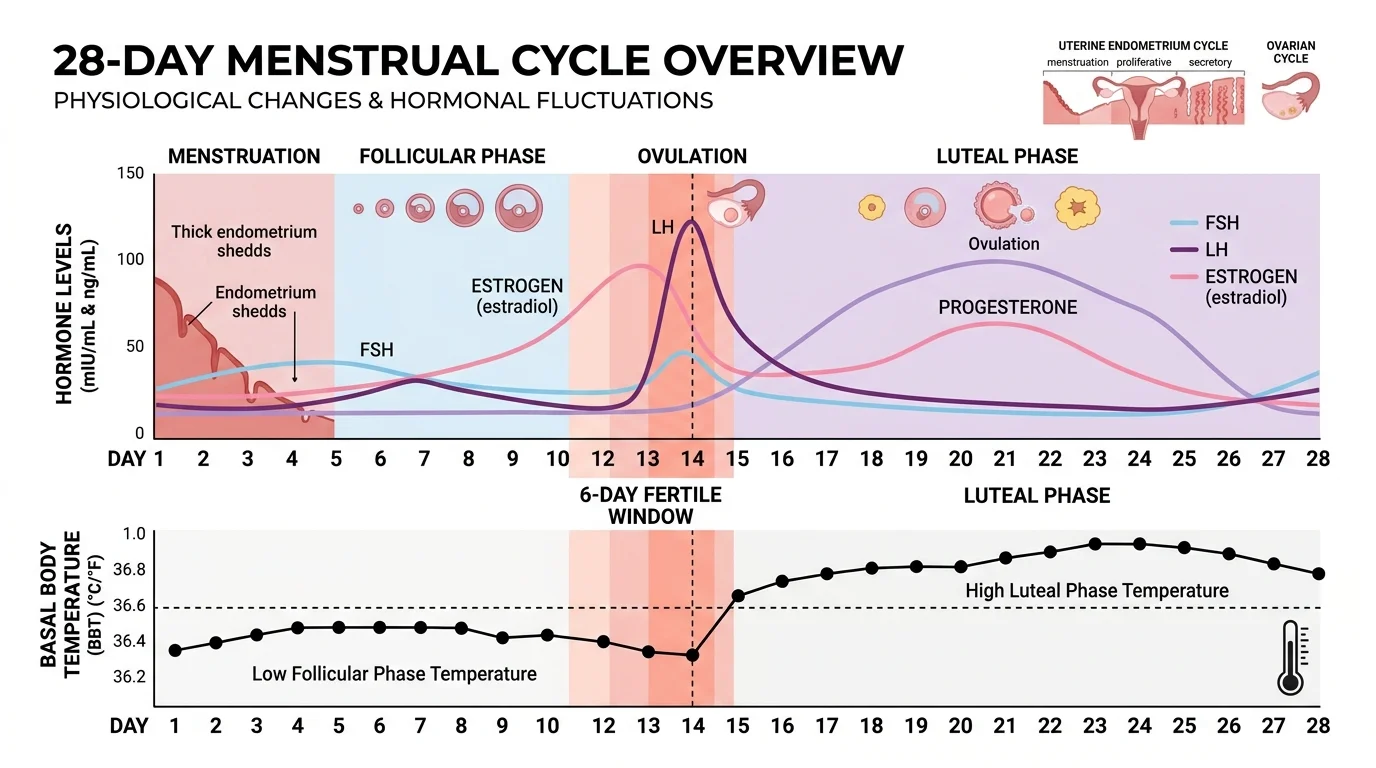
Medical Diagram

Menstrual Cycle Hormone Fluctuations & Fertile Window Chart

LH Surge • BBT Biphasic Shift • 6-Day Fertile Window
Biological fertile window timeline showing ovulation, LH surge, and peak conception days
Medical diagram showing LH surge, estrogen peak, progesterone rise, BBT basal body temperature shift, and the 6-day fertile window.Clinical physiological overview showing luteinizing hormone (LH) peaking 24–36 hours prior to follicle rupture, estrogen surge in the late follicular phase, and post-ovulation progesterone production by the corpus luteum triggering the sustained basal body temperature (BBT) shift.

Understanding the 6-Day Fertile Window

Pregnancy is only biologically possible during a 6-day timeframe in each cycle: the five days preceding ovulation plus the day of ovulation.

Primary Clinical Literature:Wilcox AJ, Weinberg CR, Baird DD. Timing of Sexual Intercourse in Relation to Ovulation. N Engl J Med. 1995. View on PubMed ↗
1
Sperm Lifespan: Up to 5 Days

Sperm can survive inside fertile cervical mucus for up to 120 hours waiting for the egg.

2
Egg Lifespan: 12 to 24 Hours

Once released, the ovum must be fertilized within 24 hours before it dissolves.

3
Peak Intercourse Timing: O-2 and O-1

Having sex 1 to 2 days before ovulation yields the highest conception rate (~31%).

Secondary Biological Signs

Complement calendar math by checking for these natural physical indicators:

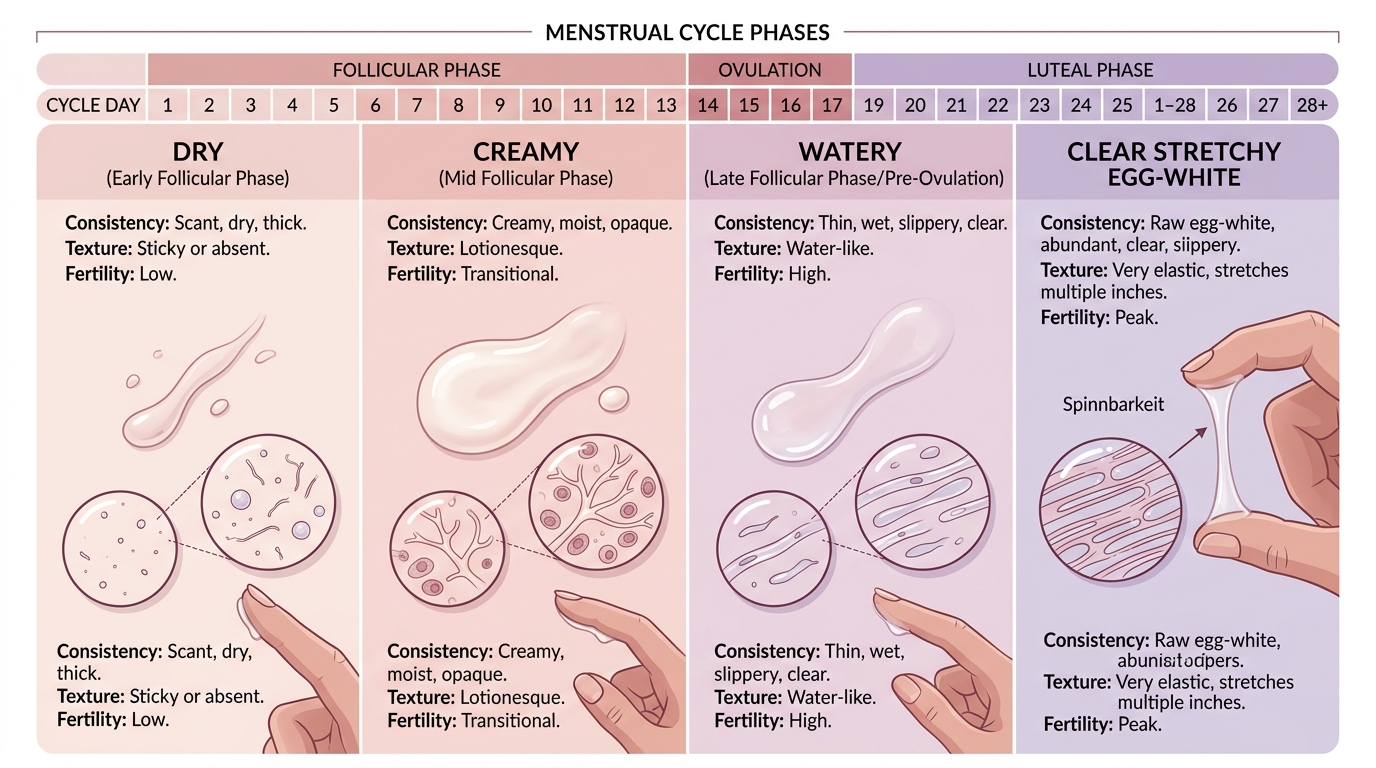
Cervical Fluid (Egg-White Consistency)

Becomes clear, stretchy, and slippery like raw egg whites during peak estrogen.

Basal Body Temperature (BBT Shift)

Rises 0.5°F–1.0°F after ovulation due to progesterone production by the corpus luteum.

Ovulation Predictor Kits (LH Surge)

Tests positive 24 to 36 hours before ovulation triggers the egg release.

Clinical diagram showing cervical mucus progression from dry, creamy, watery to raw egg-white consistency during fertile window
Clinical stages of cervical mucus from dry early follicular phase to clear, stretchy raw egg-white (spinnbarkeit) at peak fertility.
💬Common Questions

Frequently Asked Questions

Clinical answers to your fertility, cycle timing, and ovulation questions

How does an ovulation calculator work?
An ovulation calculator predicts the day an ovary releases an egg by counting backward from your expected next menstrual period. In human biology, the luteal phase (time between ovulation and the next period) is remarkably consistent at roughly 14 days (typically 11-16 days). By subtracting your luteal phase from your total cycle length, the calculator determines your estimated ovulation day and the preceding 5 fertile days.
What is the fertile window and when is the best time to have sex?
The fertile window consists of the 5 days before ovulation plus ovulation day itself—a total of 6 days. Sperm can live inside fertile cervical fluid for up to 5 days, while an egg survives for only 12 to 24 hours after release. Clinical studies show that intercourse 1 to 2 days before ovulation produces the highest probability of pregnancy (~27% to 31%).
Can I use this calculator if my menstrual cycles are irregular?
Yes! Our tracker includes an Irregular Cycle mode. By entering your shortest and longest cycle lengths over the past 6 months, the tool calculates a widened fertile window (shortest cycle minus 18 days to longest cycle minus 11 days), ensuring you cover all potential ovulation days.
How soon can I take a home pregnancy test?
Implantation typically occurs 6 to 10 days post-ovulation (DPO). The placenta then begins producing human Chorionic Gonadotropin (hCG). Sensitive early-detection home pregnancy tests can pick up hCG around 11 to 14 DPO, or on the first day of your missed period.
How does customizable cycle modeling compare to basic 14-day calculators?
Basic fixed-calendar calculators only accept a single cycle number with an assumed 14-day luteal phase and provide no daily probability breakdowns, irregular cycle adjustments, or biomarker tracking. Free Ovulation Tracker allows you to customize your personal luteal phase (10–18 days), track irregular and PCOS cycle ranges (20–90 days), visualize daily conception probabilities, preview future 6 cycles, and directly export dates to Google, Apple, and Outlook calendars.
Is my personal health data private and secure?
100% yes. All calculations are executed directly inside your web browser (client-side). We do not collect, transmit, store, or sell any of your reproductive dates or health data on any remote servers.
📖Fertility Education

Evidence-Based Fertility Guides

In-depth articles authored by women's health clinicians and fertility advocates

View All Articles → →
PCOS & Fertility

PCOS & Ovulation Tracking: Why 28-Day Calculators & OPKs Fail (And What Works)

A comprehensive clinical guide to tracking ovulation with PCOS. Learn why high baseline LH produces false-positive OPKs, how oligomenorrhea disrupts follicular phases, and how combining cervical mucus with biphasic BBT shifts unlocks conception.

✍Free Ovulation Tracker Editorial Team⏱11 min read
Post-Contraception & Loss

Tracking Ovulation After Stopping Birth Control or Pregnancy Loss: Clinical Guide

Clinical guide to tracking your fertile window after stopping oral contraceptives, IUD removal, or pregnancy loss. Understand post-pill amenorrhea vs withdrawal bleeds, Cycle Day 1 dating after miscarriage, residual hCG interference, and luteal phase normalization.

✍Free Ovulation Tracker Editorial Team⏱10 min read
Peer-Reviewed Clinical Foundation & E-E-A-T

Primary Peer-Reviewed Literature & Clinical References

The algorithmic models powering Free Ovulation Tracker are grounded in established gynecological physiology and peer-reviewed reproductive science.

  1. Wilcox, A. J., Weinberg, C. R., & Baird, D. D. (1995). Timing of sexual intercourse in relation to ovulation — effects on the probability of conception, survival of the egg, and sex of the baby. The New England Journal of Medicine (NEJM), 333(23), 1517–1521.
  2. Wilcox, A. J., Baird, D. D., & Weinberg, C. R. (1999). Time of implantation of the conceptus and loss of pregnancy. The New England Journal of Medicine (NEJM), 340(23), 1796–1799.
  3. American College of Obstetricians and Gynecologists (ACOG). (2020). Infertility Workup for the Women's Health Specialist: ACOG Committee Opinion & Practice Bulletin No. 242. Obstetrics & Gynecology, 133(6), e377–e384.
  4. World Health Organization (WHO). (2021). WHO Laboratory Manual for the Examination and Processing of Human Semen (6th ed.) & WHO Infertility and Reproductive Health Fact Sheets. Geneva: World Health Organization.
  5. Lenton, E. A., Landgren, B. M., & Sexton, L. (1984). Normal variation in the length of the luteal phase of the menstrual cycle: identification of the short luteal phase. British Journal of Obstetrics and Gynaecology (BJOG), 91(7), 685–689.
  6. Fehring, R. J., Schneider, M., & Raviele, K. (2006). Variability in the phases of the menstrual cycle. Journal of Obstetric, Gynecologic, & Neonatal Nursing (JOGNN), 35(3), 376–384.
  7. Johnson, S., Marriott, L., & Zinaman, M. (2018). Can apps and calendar methods predict ovulation with accuracy? Human Reproduction, 33(9), 1727–1734.
  8. Ali, S., et al. & Bull, J. R., et al. (2019–2020). Real-world menstrual cycle characteristics of more than 600,000 menstrual cycles. npj Digital Medicine, 2, 83.
  9. Legro, R. S., Brzyski, R. G., Diamond, M. P., et al. (2014). Letrozole versus clomiphene for infertility in the polycystic ovary syndrome. The New England Journal of Medicine (NEJM), 371(2), 119–129.
  10. Barnhart, K. T., Sammel, M. D., Rinaudo, P. F., et al. (2004). Symptomatic patients with an early viable intrauterine pregnancy: HCG curves redefined. Obstetrics & Gynecology, 104(1), 50–55.