Understanding Your Fertile Window: The Definitive Clinical Guide to Peak Fertility Days
A comprehensive, science-backed breakdown of the 6-day fertile window, gamete survival dynamics, daily conception probabilities from the Wilcox NEJM study, and optimal intercourse timing protocols.
Table of Contents
- 1Executive Summary: The Biological Reality of Conception Timing
- 21. Gamete Physiology: Why the Fertile Window Exists
- 32. Gamete Lifespan Comparison Matrix
- 43. The Landmark Wilcox Study: Daily Conception Probabilities
- 54. Cervical Mucus Dynamics: The Body's Living Compass
- 65. Optimal Intercourse Timing: Daily vs. Every-Other-Day Protocol
- 76. Clinical Myth-Busting: Evidence vs. Folklore
- 87. What About Irregular Menstrual Cycles?
- 98. Frequently Asked Questions (Clinical FAQ)
- 109. Scientific References & Peer-Reviewed Literature
§ Executive Summary: The Biological Reality of Conception Timing
One of the most persistent misconceptions in reproductive medicine is that conception can occur at any point during the menstrual cycle, or conversely, that pregnancy only happens on the exact day an egg is released. In human reproductive physiology, natural conception is constrained by a finite biological window.
Clinical reproductive investigations, most notably the landmark epidemiological studies conducted by Wilcox, Weinberg, and Baird published in The New England Journal of Medicine, have conclusively established that intercourse can result in conception on only six days during any given menstrual cycle: the five days preceding ovulation and the day of ovulation itself.
Understanding the precise timing of this 6-day window, how gamete physiology dictates success, and how to track physical biomarkers eliminates guesswork and maximizes pregnancy probabilities.
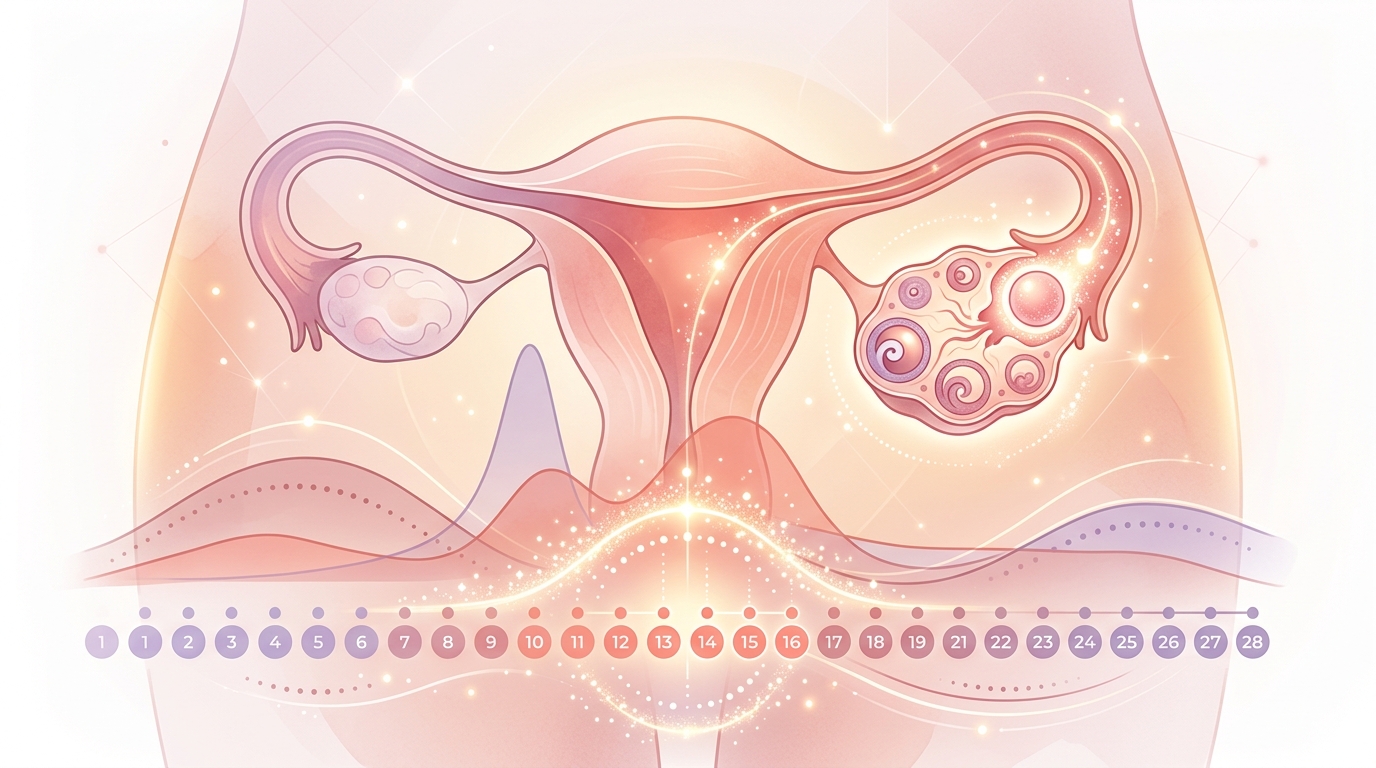
§ 1. Gamete Physiology: Why the Fertile Window Exists
The existence of a 6-day fertile window is fundamentally governed by the dramatic asymmetry between the lifespans of human spermatozoa and the secondary oocyte.
THE 6-DAY BIOLOGICAL FERTILE WINDOW
A. Sperm Longevity in the Female Reproductive Tract (Up to 120 Hours)
Under baseline conditions in the vagina, the native microenvironment is acidic (pH 3.8 to 4.5), designed to inhibit pathogenic bacterial growth. In this hostile acidic environment, ejaculated sperm perish within 30 minutes to 2 hours.
However, during the 5 to 6 days leading up to ovulation, escalating circulating estradiol produced by the developing dominant follicle triggers the endocervix to secrete voluminous, alkaline, nutrient-rich cervical fluid (Types S and L mucus). This specialized fluid:
- Neutralizes vaginal acidity, raising the local pH to an optimal 7.2 to 8.0.
- Forms microscopic parallel micellar glycoproteins that act as biological "superhighways" guiding sperm directly into the cervix.
- Provides glycogen and essential lipids that nourish sperm, allowing them to remain suspended in the cervical crypts of Blandau for up to 120 hours (5 full days).
B. Oocyte Longevity Following Rupture (12 to 24 Hours)
In sharp contrast to sperm resilience, the human secondary oocyte has a fleeting lifespan. Once the luteinizing hormone (LH) surge triggers the follicular wall of the ovary to rupture, the mature oocyte is expelled into the peritoneal space and swept into the fallopian tube (ampulla) by the fimbriae.
From the exact moment of follicular extrusion:
- The oocyte remains optimally viable for fertilization for only 12 to 18 hours.
- Beyond 18 to 24 hours, the cumulus oophorus disperses, the zona pellucida hardens, and intracellular spindle fibers degenerate, precluding fertilization.
- If fertilization does not occur within this 24-hour post-ovulatory window, the egg is phagocytized and absorbed.
C. The Critical Phenomenon of Sperm Capacitation
Why is having sex on the day of ovulation less effective than having sex 1 to 2 days before? The answer lies in capacitation.
Sperm do not emerge from ejaculate capable of immediate fertilization. Upon entering the uterus and fallopian tubes, sperm must spend 5 to 10 hours undergoing biochemical remodeling:
- Removal of decapacitating seminal plasma cholesterol from the acrosome membrane.
- Influx of extracellular calcium, triggering hyperactivated motility (whiplash tail beating).
- Priming of acrosomal enzymes (hyaluronidase and acrosin) necessary to digest through the protective cells surrounding the egg.
Clinical Insight: If intercourse takes place after ovulation has already occurred, by the time the sperm navigate through the cervix, ascend the uterine cavity, and complete their 6-to-10-hour capacitation process, the aging egg is frequently already non-viable. Conversely, when sex occurs on day O-2 or O-1, fully capacitated sperm are already stationed in the fallopian ampulla waiting for the egg the exact millisecond it arrives.
§ 2. Gamete Lifespan Comparison Matrix
| Physiological Variable | Human Spermatozoa (Male Gamete) | Secondary Oocyte (Female Gamete) | Clinical Implication |
|---|---|---|---|
| Viability Window | Up to 120 hours (5 days) in fertile mucus | 12 to 24 hours post-follicular rupture | Intercourse must precede or coincide with egg release. |
| Optimal Microenvironment | Alkaline (pH 7.2 – 8.5) rich in glucose & albumin | Fallopian tubal fluid (ampulla region) | Acidic vaginal conditions destroy sperm without fertile mucus. |
| Fertilization Readiness | Requires 5–10h capacitation in female tract | Ready immediately upon meiotic metaphase II arrest | Intercourse 24–48h prior to ovulation produces superior results. |
| Survival Without Mucus | 30 minutes to 2 hours in acidic vagina | N/A (Internal within peritoneal/tubal tract) | Days with dry/sticky mucus offer virtually zero sperm survival. |
| Genetic Payload | 23,X or 23,Y (determines chromosomal sex) | 23,X | Sperm determine the biological sex of the offspring. |
§ 3. The Landmark Wilcox Study: Daily Conception Probabilities
In their seminal prospective investigation, Dr. Allen Wilcox and colleagues from the National Institute of Environmental Health Sciences (NIEHS) monitored 221 healthy women attempting to conceive, analyzing 696 menstrual cycles using daily laboratory assays of urinary estrogen and progesterone metabolites to pinpoint the exact biological day of ovulation.
Their definitive findings revealed the exact statistical odds of clinical pregnancy resulting from intercourse on any specific day relative to ovulation (Day 0):
| Day Relative to Ovulation | Statistical Conception Probability (%) | Biological Microenvironment State | Intercourse Recommendation |
|---|---|---|---|
| Day O - 6 | < 1% | Scant, infertile progesterone mucus | Very low probability; baseline |
| Day O - 5 | ~10% | Early follicular phase; early estrogen rise | Good starting intercourse day |
| Day O - 4 | ~16% | Cervical crypts begin producing watery fluid | Conception window clearly active |
| Day O - 3 | ~14% | Follicle diameter reaches ~16mm; high estrogen | High priority day for intercourse |
| Day O - 2 | ~27% | Peak estrogen surge; copious Spinnbarkeit mucus | PRIME PEAK DAY: Highest cumulative conception rate |
| Day O - 1 | ~31% | LH surge underway; ideal capacitation timing | HIGHEST SINGLE-DAY PROBABILITY |
| Day 0 (Ovulation) | ~12% | Follicular rupture; egg viable for 12–24h | Favorable, but rapid time decay |
| Day O + 1 | ~0% to 2% | Corpus luteum produces progesterone; mucus dries | Window is closed; fertilization improbable |
Interpreting the Statistics:
- The 48-Hour Peak: Nearly 60% of all successful conceptions occur when intercourse happens on either Day O-1 or Day O-2.
- The "Day Zero" Drop-off: The chance of conceiving from intercourse on ovulation day (~12%) is less than half the chance of conceiving on the day before ovulation (~31%).
- The Closure of the Window: Within 24 hours of ovulation, the surge of progesterone causes the cervix to contract and form a dense, thick, impenetrable mucus plug that blocks any additional sperm from entering the uterine cavity.
§ 4. Cervical Mucus Dynamics: The Body's Living Compass
While digital ovulation algorithms provide an accurate mathematical framework, tracking your body's physical biological markers—specifically cervical fluid—provides real-time confirmation of your follicular phase.
Under the influence of rising estradiol produced by the granulosa cells of the maturing ovarian follicle, cervical secretions undergo a predictable, progressive transformation:
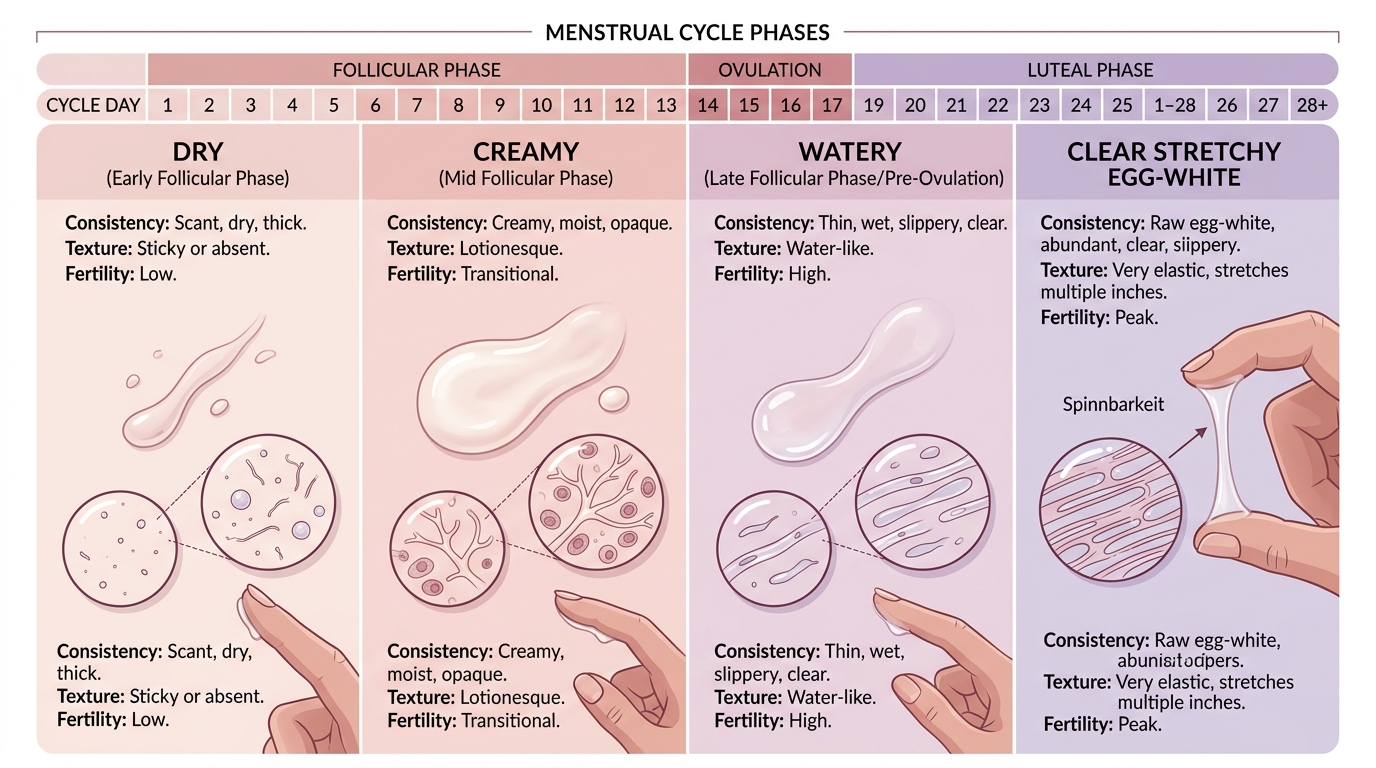
Phase 1: Dry / Sticky (Cycle Days 4–7)
- Hormonal Profile: Baseline estrogen, low progesterone.
- Physical Characteristics: Vaginal sensation feels dry or slightly damp. Mucus is thick, paste-like, crumbly, or rubbery.
- Microscopic Architecture: Dense cross-linked protein mesh (Type G mucus) that traps and immobilizes sperm.
- Fertility Potential: Infertile.
Phase 2: Creamy / Lotion-Like (Cycle Days 8–10)
- Hormonal Profile: Rising estrogen as secondary follicles expand.
- Physical Characteristics: Looks and feels like hand lotion, facial cream, or whole milk; pearly white or light yellow.
- Microscopic Architecture: Viscosity decreases; fluid begins to form rudimentary linear channels.
- Fertility Potential: Low to Moderate. Sperm may survive 24 to 48 hours.
Phase 3: Watery & Slippery (Cycle Days 11–12)
- Hormonal Profile: Rapid pre-ovulatory estradiol spike.
- Physical Characteristics: Clear, thin, fluid, exceptionally slippery. Often creates a noticeable wet sensation on underwear.
- Microscopic Architecture: High water content (95%+), low cellularity.
- Fertility Potential: High. Excellent sperm transit environment.
Phase 4: Egg-White Cervical Mucus (EWCM) / Spinnbarkeit (Cycle Days 13–15)
- Hormonal Profile: Peak estradiol triggering the positive feedback loop for the LH surge.
- Physical Characteristics: Completely transparent, glossy, and elastic. Resembles raw egg whites. Can stretch 1 to 3 inches between fingers without snapping (termed Spinnbarkeit in gynecological literature).
- Microscopic Architecture: Aligned mucin micellar chains (Type S and L mucus) that actively nourish, filter abnormal sperm, and provide low-resistance conduits straight into the internal os.
- Fertility Potential: PEAK FERTILITY. Correlates with the highest conception probabilities of the cycle.
§ 5. Optimal Intercourse Timing: Daily vs. Every-Other-Day Protocol
Couples trying to conceive frequently ask: "Should we have sex every single day, or does that lower sperm count?"
The American Society for Reproductive Medicine (ASRM) clinical guidelines on optimizing natural fertility provide evidence-based clarity:
The Evidence on Ejaculatory Frequency
- Historical Myth: For decades, it was assumed that daily intercourse would deplete male sperm reserves and that couples should save up semen by abstaining for several days.
- Modern Clinical Consensus: Extensive semen analyses demonstrate that in men with normal baseline sperm parameters, daily intercourse does NOT compromise fertility. While semen volume and absolute sperm count per ejaculation decrease slightly with daily ejaculation, sperm motility, viability, and DNA integrity actually improve because sperm spend less time in the epididymis exposed to oxidative stress.
- The Ideal Frequency: The ASRM concludes that having intercourse every 1 to 2 days throughout the 6-day fertile window yields the highest clinical pregnancy rates.
The Recommended Intercourse Schedule
For a typical 28-day cycle with estimated ovulation on Day 14:
- Cycle Day 10 (O-4): Intercourse (establishes initial sperm reservoir).
- Cycle Day 12 (O-2): Intercourse (first prime peak fertility day).
- Cycle Day 13 (O-1): Intercourse (highest single-day probability).
- Cycle Day 14 (Ovulation Day): Intercourse (covers the immediate post-ovulatory hours).
Avoid Sperm-Toxic Lubricants
A major hidden obstacle to conception is the use of standard over-the-counter vaginal lubricants. Common household lubricants (including K-Y Jelly, Astroglide, saliva, and silicone-based products) are hyperosmotic, contain parabens, and actively inhibit sperm motility by 60% to 100% within 15 minutes of contact.
If lubrication is needed, use only FDA-cleared fertility-friendly lubricants (formulated with hydroxyethylcellulose or arabinogalactan at isotonic pH 7.2 to 7.4) that have been clinically tested not to impede sperm swimming velocity or cause DNA damage.
§ 6. Clinical Myth-Busting: Evidence vs. Folklore
Myth 1: "Every woman ovulates on Cycle Day 14."
Reality: The "Day 14" ovulation myth is an artifact of medical textbooks averaging across populations. In an extensive epidemiological study of over 30,000 menstrual cycles published in the British Medical Journal (BMJ), fewer than 13% of women with regular 28-day cycles ovulated precisely on Day 14. Ovulation routinely fluctuates between Day 11 and Day 21 depending on follicular development velocity, emotional stress, and sleep disruption.
Myth 2: "You can only get pregnant if you have sex on the day of ovulation."
Reality: As demonstrated by the Wilcox study, having intercourse exclusively on the day of ovulation results in a conception rate of only ~12%, whereas having sex on the day before ovulation yields a 31% success rate.
Myth 3: "It is impossible to get pregnant from intercourse during your period."
Reality: While improbable for women with standard 28-to-32-day cycles, it is entirely possible for women with short cycles (e.g., 21 to 24 days). In a 21-day cycle, ovulation occurs around Cycle Day 7. If intercourse occurs on Day 4 of active menstrual bleeding, sperm surviving 4 to 5 days can easily fertilize an egg released on Day 7 or 8.
Myth 4: "Lying with your legs in the air for 30 minutes improves pregnancy rates."
Reality: Comprehensive reproductive studies (including randomized trials on intrauterine insemination bed rest) have confirmed that elevating the pelvis has zero measurable impact on pregnancy rates. Millions of motile sperm enter the cervical mucus within seconds of ejaculation; fluid that leaks out afterward consists primarily of prostatic secretions and non-motile cells.
§ 7. What About Irregular Menstrual Cycles?
When cycles vary significantly in length (e.g., 26 days one month, 36 days the next), calculating a static ovulation day using simple calendar subtraction becomes unreliable.
The Rhythm Method Range Formula
For irregular cycles, clinicians recommend calculating a widened fertile window:
- Track your cycle lengths over the past 6 months to determine your shortest cycle and longest cycle.
- First Fertile Day = Length of Shortest Cycle minus 18 days.
- Last Fertile Day = Length of Longest Cycle minus 11 days.
Example:
- Shortest cycle in last 6 months = 26 days
- Longest cycle in last 6 months = 35 days
- Fertile Window Begins: 26 - 18 = Cycle Day 8
- Fertile Window Ends: 35 - 11 = Cycle Day 24
Having intercourse every 2 to 3 days between Cycle Day 8 and Cycle Day 24 guarantees that viable sperm are present regardless of when your follicle matures and ruptures.
§ 8. Frequently Asked Questions (Clinical FAQ)
When is the earliest I can take a reliable home pregnancy test?
Implantation of the blastocyst into the vascularized uterine lining occurs between 6 and 10 days post-ovulation (DPO). Once implanted, trophoblastic tissue begins producing human Chorionic Gonadotropin (hCG), which doubles approximately every 48 hours. The earliest sensitive home pregnancy tests (detecting 10–25 mIU/mL of hCG) become positive around 11 to 14 DPO, or on the first day of your expected missed period. Testing before 10 DPO yields a high rate of false-negative results.
Does an LH surge guarantee that ovulation took place?
No. An LH test strip (Ovulation Predictor Kit) detects the presence of circulating luteinizing hormone in your urine, which signals that your pituitary gland has directed the ovary to release an egg. However, in conditions like Polycystic Ovary Syndrome (PCOS) or Luteinized Unruptured Follicle (LUF) syndrome, the follicle may fail to rupture despite a positive LH surge. Ovulation can only be confirmed after the fact by a sustained thermal shift in Basal Body Temperature (BBT) or a serum progesterone blood test taken 7 days past ovulation (target > 3 ng/mL).
Can stress delay ovulation and shift the fertile window?
Yes. The hypothalamic-pituitary-ovarian (HPO) axis is sensitive to elevated cortisol and corticotropin-releasing hormone (CRH). Severe physiological stress, extreme caloric deficit, strenuous overtraining, or acute emotional distress can suppress pulsatile GnRH release from the hypothalamus, delaying follicular maturation by several days or weeks, or resulting in a temporary anovulatory cycle.
§ 9. Scientific References & Peer-Reviewed Literature
- Wilcox AJ, Weinberg CR, Baird DD. Timing of sexual intercourse in relation to ovulation — effects on the probability of conception, survival of the pregnancy, and sex of the baby. New England Journal of Medicine. 1995;333(23):1517-1521. DOI: 10.1056/NEJM199512073332301.
- Practice Committee of the American Society for Reproductive Medicine. Optimizing natural fertility: a committee opinion. Fertility and Sterility. 2017;107(1):52-58. DOI: 10.1016/j.fertnstert.2016.09.029.
- Dunson DB, Baird DD, Wilcox AJ, Weinberg CR. Day-specific probabilities of clinical pregnancy based on two studies with imperfect measures of ovulation. Human Reproduction. 1999;14(7):1835-1839.
- World Health Organization. WHO Laboratory Manual for the Examination and Processing of Human Semen. 6th Edition. Geneva: World Health Organization; 2021.
- Bigelow JL, Dunson DB, Stanford JB, et al. Mucus observations in the fertile window: a better predictor of conception than timing of intercourse. Human Reproduction. 2004;19(4):889-892.
Medically Reviewed & Fact-Checked
Board-Certified Obstetrician & Gynecologist. Clinical fellow in reproductive endocrinology, Johns Hopkins University School of Medicine.
Every statistic and biological model adheres to peer-reviewed clinical research and contains zero pharmaceutical sponsorships or commercial bias.
Related Clinical Articles
View All Articles →Luteal Phase Explained: Why the Second Half of Your Cycle Dictates Pregnancy Success
An in-depth clinical analysis of the luteal phase, progesterone synthesis by the corpus luteum, blastocyst implantation mechanics, and managing luteal phase deficiency.
Cervical Mucus & Basal Body Temperature: The Complete Sympto-Thermal Guide
Master the Sympto-Thermal Method. Learn how to interpret cervical fluid Spinnbarkeit consistency and confirm ovulation through biphasic basal temperature curves.
Ovulation Calculator vs. Ovulation Predictor Kits (OPKs): Which Is More Accurate?
Understand the distinct roles of algorithm-based cycle calculators and biochemical luteinizing hormone (LH) urine test strips in fertility planning.